Wind turbines and solar panels: do you
love them or hate them? Do you think of renewable energy as the way to a
greener future, or an awful blight on the present? Either way, growing numbers of German communities think they have found a
silver lining: they’re touting renewables as tourist attractions. A guidebook
is now available, listing about 200 green projects around the country
which it thinks are, in the travel writer’s time-hallowed phrase, “worth
the detour”. The publication, which has already run to a second edition
after the first sold out, was supported by Germany’s Renewable Energies Agency.
Nuclear power stations are not top of every tourist’s must-see list.
But the book’s author, Martin Frey, says a nuclear plant in Kalkar, a
town on Germany’s border with the Netherlands, is the world’s safest. It
pulls in more than half a million visitors annually. Safe? It should be, because local protests – driven partly by the
1986 Chernobyl accident – meant it never started operation. Now it’s an amusement park
offering hotels with all-inclusive holidays, restaurants and
merry-go-rounds. Its most popular attraction is a gigantic cooling tower
with a climbing wall outside and a carousel inside.
Another strictly retired “attraction” listed is Ferropolis,
the City of Iron. Located on the site of a former brown coal (lignite)
opencast mine in the eastern German state of Saxony-Anhalt, it’s a bit
of an oddity in Frey’s list – an open-air museum, preoccupied not with
emerging technologies but with echoes of one that many hope has had its day. Huge redundant metal structures, immense excavators and towering
cranes, all abandoned, give Ferropolis the air of a post-apocalypse
movie. But in a nod to the future the roof of a former workshop is
covered with solar panels which help to power the museum’s annual summer
music festivals.
Germany is moving rapidly away from the past which Ferropolis evokes
in its switch to renewable energy. In the last decade renewable power
generation has tripled and now provides a quarter of the country’s
electricity and about 380,000 jobs. Wind, hydro, solar and biogas plants
are taking over from coal and nuclear power. The change is evident right at the heart of the nation’s political
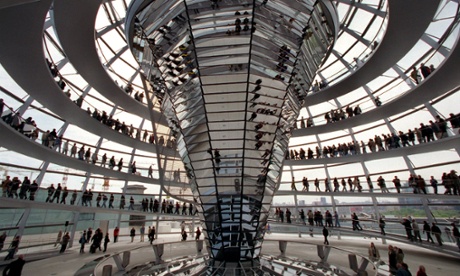
life. The glass dome of the Reichstag, a tourist magnet which stands
resplendent on the Berlin skyline, contains a cone covered with 360
mirrored plates, which reflect sunlight and illumine the plenary hall
below. And there’s more: a heat exchanger inside the cone’s ventilation
shaft significantly reduces the building’s power consumption. The Reichstag also boasts an array of solar panels, and half its
electricity and most of its heat come from two combined heat and power
generators beneath the building, which run on bio-diesel.
If you want to combine some mildly energetic activity with your
environmental sightseeing, then head for Lower Saxony where you’ll find
the Holtriem wind farm. The largest in Europe when it was built, with a
total capacity of 90 MW, it has an observation platform on one of the
turbines, 65 metres above ground. That offers tourists – if they’re prepared
to climb the 297 steps to the top – a stunning view of the North Sea
and, in good weather, the East Frisian islands. Also in Lower Saxony is Juehnde, the first German village to achieve
full energy self-sufficiency. Its combined heat and power plant produces
twice as much energy as Juehnde needs. The villagers are so keen to
share their experience that they built a new energy centre to win over visitors.
Frey, a journalist specialising in renewable energy, says he wrote
the book because he’d been impressed by a large number of innovative
renewable projects and wanted to share them with tourists as well as
experts.
• Germany: Experience Renewable Energies, published by
Baedeker, is available in German (and only in print) for €16.99. An
English language version may be produced if there is enough demand.


No comments:
Post a Comment